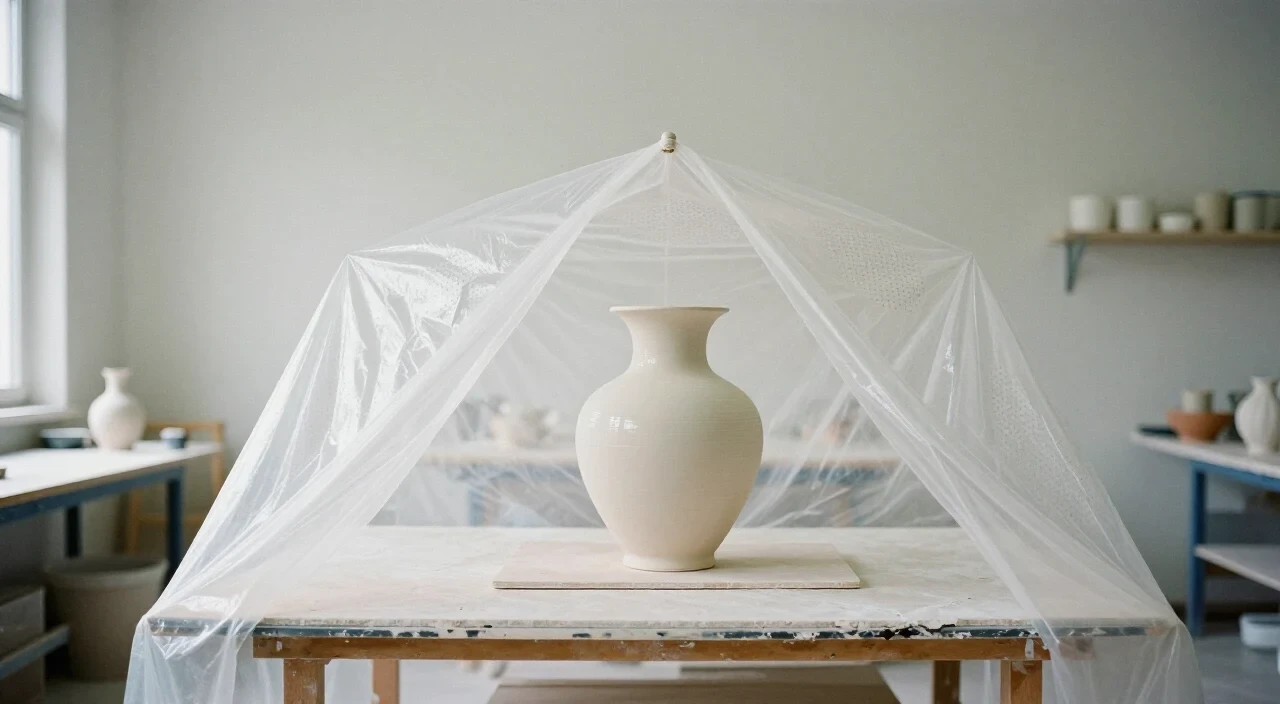
Prevent warping by drying the vase slowly and uniformly: keep the piece on a porous support, tent it with breathable plastic, protect thin rims and handles, rotate the vase periodically, and log moisture changes until it reaches leather-hard before any forced drying.
Table of Contents
- 01How long should a large ceramic vase dry before firing?
- 02Should I cover a tall vase with plastic while it dries?
- 03How do I stop a pottery vase rim from warping?
- 04Can I use a fan or heater to speed up drying of a large vase?
- 05Frequently asked questions (in the article's language)
- 06Sources
- 07Read next
Key takeaways (in the article's language)
- Dry slowly on a porous surface
- Tent with breathable plastic, not airtight
- Rotate the vase when it can support its own weight
- Log moisture level and stop forced drying until leather-hard
How long should a large ceramic vase dry before firing?
A large vase typically needs 14 to 21 days of gradual drying, but the exact time depends on wall thickness, clay body, humidity, and airflow in the studio. Monitor the piece daily; when the surface feels cool and the weight has reduced uniformly, it is approaching the leather-hard stage.
At Kaolin Ceramics Studio we place each vase on a wooden board or plaster bat that absorbs moisture from the base. The board is left on a bench away from direct sunlight, heaters, and drafts. A loose plastic tent, perforated with a few pin-holes, covers the piece for the first week to slow evaporation from the rim and handles.
After five to seven days the tent is lifted partially, allowing the upper surface to breathe while the base continues to dry slowly. Around day ten the vase is turned gently on its side, if the foot is sturdy enough, to equalise moisture between the lower and upper walls. The rotation is repeated every two to three days until the clay feels firm but still cool to the touch.
A simple drying log records the date, ambient temperature, humidity, and any visual signs of warping. When the log shows a steady decline in weight and no visible distortion, the piece is ready for the weekly kiln firing.
Should I cover a tall vase with plastic while it dries?
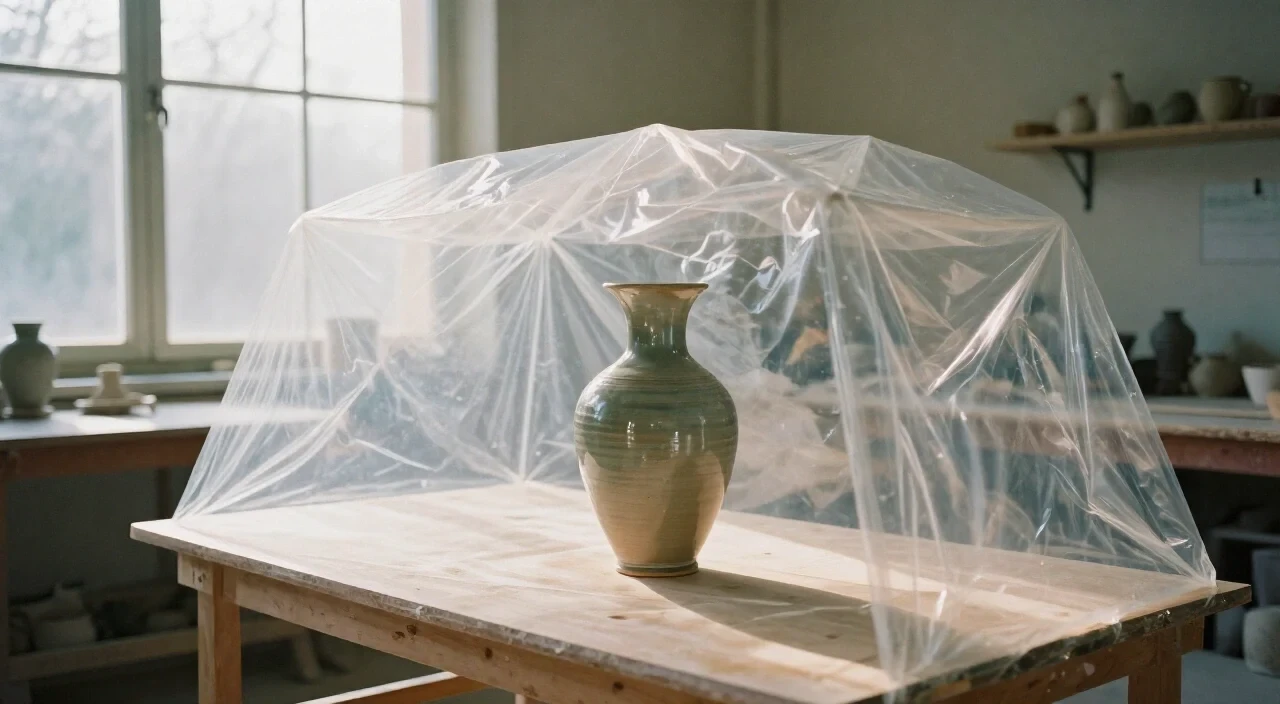
Covering with breathable plastic is recommended for the first week, but the plastic must be tented—not sealed—so that air can circulate and moisture loss stays even across thin rims and thick walls.
In our Porto studio we use a clear, low-density polyethylene sheet draped loosely over the vase and secured with a few clothespins. Small holes are punched every few centimeters; this creates a micro-climate that slows the fastest-drying areas without trapping condensation.
If the plastic is wrapped tightly, the rim dries much faster than the body, causing the top edge to pull inward and warp. Conversely, leaving the piece uncovered from the start leads to rapid drying of the upper surface while the base stays damp, producing an oval foot.
After the initial seven days the tent is opened gradually: first remove a corner, then a side, checking for any signs of pulling or cracking. This staged exposure lets the remaining moisture escape at a controlled rate, keeping the whole vase in balance.
In our Porto studio we use a clear, low-density polyethylene sheet draped loosely over the vase and secured with a few clothespins.
How do I stop a pottery vase rim from warping?
Protect the rim with a thin layer of damp cloth or a porous fabric and keep it under the same plastic tent as the rest of the vase; this equalises drying speed and prevents the edge from curling inward.
When a vase is formed, the rim is often thinner than the walls. At Kaolin we place a small square of clean cotton fabric over the rim before covering the whole piece. The fabric stays slightly moist, slowing evaporation from the edge while the rest of the vase dries.
As the vase reaches the leather-hard stage, the fabric is removed and the rim is checked for any slight lift. If a lift is detected, a gentle mist of water is sprayed on the rim and the tent is reseated for another 12-24 hours. This brief re-moistening allows the clay fibers to relax and settle back into a flat plane.
Avoid handling the rim once it feels firm; any pressure can create micro-cracks that later expand in the kiln. Regular visual checks and a light touch are the safest way to keep the rim true.
Can I use a fan or heater to speed up drying of a large vase?
No, forced airflow or heat should be avoided until the vase reaches the leather-hard stage; premature drying creates uneven shrinkage and increases the risk of warping or cracking.
A fan blows dry air across the surface, which dries the thin walls and rim far faster than the thick base. The resulting moisture gradient pulls the walls inward, producing an oval foot or a split rim. A heater raises ambient temperature, accelerating evaporation but also drying the outermost layer too quickly.
At Kaolin we keep the drying area at a stable room temperature (around 18-20 °C) and rely on natural convection. Only after the clay feels firm and cool do we allow a gentle, low-speed fan for a short period—no more than 30 minutes—to remove residual surface moisture before loading the piece into the kiln.
If a faster schedule is required for a class project, the safest option is to make the vase thinner and more uniform from the start, rather than trying to accelerate drying with heat or fans.
Never seal a freshly shaped vase completely; always use a tented cover that can be opened gradually to let moisture escape evenly.
Frequently asked questions (in the article's language)
How can I tell when a large vase is leather-hard?
Touch the surface; it should feel cool and firm, and a faint indentation from a fingernail should not rebound. The weight will have dropped noticeably compared with the wet stage.
What wall thickness is safe for a tall vase?
Keep the walls between 6 mm and 10 mm for most stoneware bodies. Thicker walls dry slower and are more prone to internal stress; thinner walls may dry too fast and crack.
What should I do if warping starts during drying?
Moisten the warped area lightly with a spray bottle, re-tent the piece, and allow it to relax for another 12-24 hours. Monitor closely; if the warp worsens, consider re-shaping while the clay is still soft.