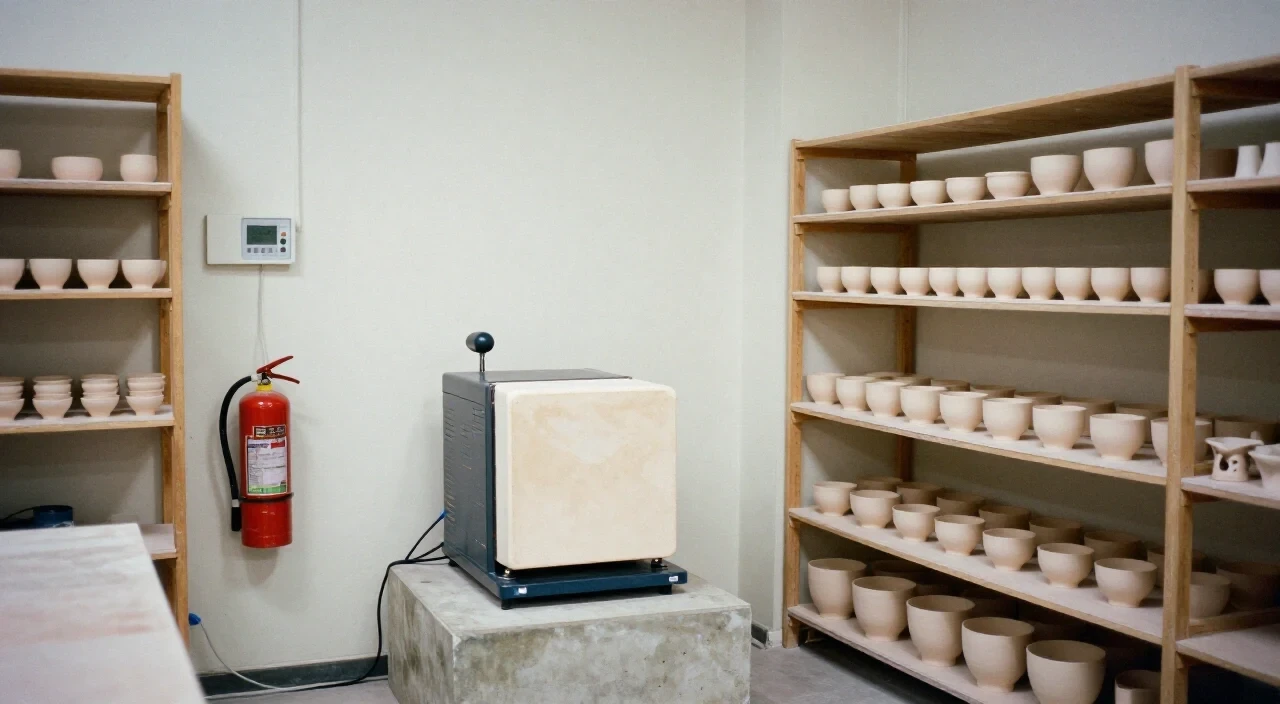
Kiln firing schedules for winter combine slower heating, careful cooling, and off-peak electricity use, giving beginners a repeatable plan for bisque and glaze firings while managing Porto’s colder nights and higher tariffs, and ensuring safety with proper ventilation and load handling.
Table of Contents
- 01Which bisque firing schedule works best in winter?
- 02How long should a kiln be allowed to cool before opening in winter?
- 03Is it cheaper to run a kiln during off-peak hours in Portugal’s winter?
- 04What does a complete beginner winter firing calendar look like?
- 05Frequently asked questions
- 06Sources
- 07Read next
Key takeaways
- Bisque schedule: 100 °C/h to 250 °C, then 150 °C/h to 600 °C, finish at 950 °C.
- Cool down: prop at 300 °C, open at 200 °C, 6–12 h total.
- Off-peak electricity can reduce cost after the 2026 tariff change.
- A two-week block per firing type keeps the studio organized.
Which bisque firing schedule works best in winter?
The most reliable winter bisque schedule ramps at 100 °C per hour to 250 °C, then 150 °C per hour to 600 °C, holds briefly, and finishes at 950 °C before a controlled cool-down; it suits most stoneware and porcelain bodies and provides a stable, fully sintered blank for glaze work.
This schedule follows the example from a kiln-firing teaching guide and respects the thermal mass of a typical studio kiln. Start by loading the kiln on a weekday morning, allowing a 1-hour pre-heat to check ventilation and remove any combustible items. Increase temperature at the prescribed rates, monitoring with the kiln’s pyrometer. Once 950 °C is reached, maintain for 10-15 minutes to ensure full vitrification, then begin the cooling phase.
Key steps:
- Verify the kiln’s power rating matches the studio’s electrical capacity.
- Keep the work area free of dust; wear fine-particle respiratory protection when handling dry powders.
- Follow manufacturer safety rules before touching the kiln.
- Record the ramp rates for future reference; minor adjustments may be needed for different clay bodies.
Common mistake: applying a high-fire schedule to bisque, which can cause warping. Adjust the final temperature down if the clay is very porous or the load is unusually heavy.
How long should a kiln be allowed to cool before opening in winter?
In winter, wait until the kiln temperature drops to about 300 °C before propping the door open, then let it cool to 200 °C before fully opening; this typically requires 6–12 hours depending on load size and ambient temperature, preventing thermal shock and cracking.
Cooling is as critical as heating. After the bisque or glaze peak, reduce power to allow a gradual descent. At 300 °C, place a heat-resistant prop to keep the door slightly ajar; this lets residual heat escape while maintaining enough warmth to avoid rapid contraction. When the reading reaches 200 °C, remove the prop and open the door fully to finish the cool-down.
Checklist for safe cooling:
- Use a calibrated kiln thermometer; ignore external room temperature.
- Keep the kiln area well-ventilated to disperse heat and any fumes.
- Do not touch the kiln walls until the temperature is below 100 °C.
- Inspect shelves and pieces for any signs of stress before unloading.
Mistake to avoid: opening the kiln too early, which often leads to cracked bisque ware or glaze crazing. Always respect the manufacturer’s minimum cooling recommendations, even if the studio schedule feels tight.
Is it cheaper to run a kiln during off-peak hours in Portugal’s winter?
Since the regulated market added €0.005 /kWh on 1 October 2026 and introduced bi-hourly peak/off-peak periods, running a kiln during off-peak times can lower the electricity bill by a few percent, though exact savings depend on the studio’s contract and load.
Porto’s winter evenings often fall into the off-peak window defined by ERSE’s bi-hourly plan. Schedule the high-energy phase of a firing (the ramp to 950 °C or 1200 °C) to start just after the off-peak period begins, typically after 22:00, and let the kiln finish its cycle while rates remain low. The slower cooling phase can continue into the next day’s peak period, as it consumes far less power.
Practical steps:
- Confirm the studio’s electricity contract is on a regulated-market bi-hourly tariff.
- Program the kiln controller with a delayed start aligned to off-peak hours.
- Monitor the total kWh used; compare with a baseline firing run during peak hours.
- Keep a log of any temperature deviations caused by the later start; adjust ramp rates if needed.
A common mistake is assuming the tariff increase automatically applies; many studios have private contracts with fixed rates. Verify with the utility provider before relying on off-peak savings.
Safety tip: Propping the kiln door open at 300 °C and fully opening it at 200 °C only after confirming the kiln surface is cool to the touch follows manufacturer guidelines and helps avoid thermal shock.
What does a complete beginner winter firing calendar look like?
An effective winter calendar spreads bisque, low-fire glaze and high-fire glaze firings over two-week blocks, each beginning on a weekday, allowing 24 hours for loading, the firing schedule, a 6-12 hour cool-down, and safe unloading before the next load, and giving time for any necessary adjustments.
Week 1 (Monday-Wednesday): Load bisque pieces, start the bisque schedule on Monday morning, finish the ramp by Thursday afternoon, then begin the controlled cool-down. Keep the kiln propped at 300 °C overnight; fully open at 200 °C on Friday morning and unload safely.
Week 2 (Monday-Wednesday): Load low-fire glaze pieces, fire to 1100 °C using the example schedule (100 °C/h to 250 °C, 150 °C/h to 600 °C, then full power to 1100 °C). Hold for 10 minutes, then cool as before. Unload Friday.
Week 3 (Monday-Wednesday): Load high-fire glaze work, follow the high-fire schedule (100 °C/h to 250 °C, 150 °C/h to 600 °C, full power to 1100 °C, then 150 °C/h to 1200-1250 °C). After the peak, allow a 6-12 hour cool-down, then unload.
Throughout the calendar:
- Verify ventilation before each firing; winter winds in Porto can be unpredictable.
- Check the studio’s electrical panel for available capacity before starting a new load.
- Keep a firing log noting ramp rates, hold times, and any deviations.
- Use the off-peak window for the most power-intensive ramps to reduce cost.
By respecting these blocks, a beginner avoids overlapping cool-downs, reduces the risk of overheating the electrical circuit, and maintains a steady workflow during the colder months.
Frequently asked questions
What temperature should bisque firing reach?
A bisque firing typically peaks at 950 °C for stoneware or porcelain, providing enough vitrification for glaze adhesion while keeping the ware porous enough to absorb glaze.
Should kiln firing schedules change in cold weather?
Only the cooling phase needs adjustment; keep the heating ramps the same but allow extra time for the kiln to lose heat to the colder studio air, usually by propping the door at 300 °C.
How can I verify my studio’s electricity tariff?
Contact the local utility or check the ERSE website for the current regulated-market rates. Confirm whether your contract is on a bi-hourly plan; only then will off-peak firing produce measurable savings.